
Cells (Gr. 8)
This post will contain all of the grade 8 lessons on cells. Students will be learning about the structures and functions of plant and animal cells and identifying the role of specialized cells in multicellular organisms. They will use microscopes and digital tools to observe cells, compare their structures, and investigate how different parts of the cell contribute to life processes. Later in this section, students will learn how to identify the major organelles in plant and animal cells and describe the functions they perform, and how cells form tissues and organs. We will begin by exploring the principles of cell theory.
Lesson 1: Cell Theory
4.2 Postulates of the Cell Theory (Read and answer questions 1 -3)
Lesson 2: Plant and Animal Cells
- 4.5 Plant and Animal Cells (Read and answer question 4 at the end of the text)
- Organelle chart example (From question 4 above)
- Plant vs. Animal Cell Labelling Sheet 1 (Make a copy and save it to your Cells folder)
Lesson 3: The Compound Microscope
- 4.3 – The Compound Microscope (Read and answer questions 2-5 at the end of the text)
2. Microscope Labelling Diagram (Make a copy and fill in the blanks)
3. Microscope Labelling Diagram Solutions
Lesson 4: Advances in Microscopy
- 4.8 – Advances in Microscopy (Read and answer questions 2 – 6)
- Add Mitochondria, Ribosomes, Endoplasmic Reticulum, Golgi apparatus, and Lysosomes to your cell organelle and function study sheet (lesson 2).
- Animal vs. Plant Cell Labelling Sheet # 2
- Solutions to Labelling Sheet # 2
- Organelle Functions (Full set)
Lesson 5: Comparing Plant & Animal Cells Lab
- Lab Rubric (Review with your group before beginning the lab)
- Cells Lab Instructions Page 1
- Cells Lab Instructions Page 2
- Lab sheet for students (make a copy for yourself)
- Microscope Cell Drawing Template
Lesson 6: Selectively Permeable Membranes
5.1 – The Cell Membrane (Answer questions #1-3 and add to your Cells folder)
Lesson 7: Diffusion and Osmosis
5.2 – Diffusion (Answer questions #2, 4, 5, and add to your Cells folder)
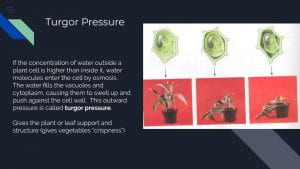
5.3 – Osmosis and Turgor Pressure (Answer questions #2, 3, 4, and add it to your Cells folder)
Here is a presentation on Osmosis and Turgor Pressure that may help you understand the concepts.
I realized that the screen went black on the last slide of the screencast. Here is the slide on Turgor Pressure to accompany the audio.
Lesson 8: Cell Wars – Defending against invaders
Cell Wars Student Note link (Make a copy, add it to your Cells folder and answer questions #1-3)
Lesson 9: Cell Systems
The Levels of Organization
Lesson 10: Unicellular Organisms
Unicellular Organisms Defined:
Unicellular organisms are composed of a single cell, unlike multicellular organisms, which are made of many cells. This means they each live and carry out all of their life processes as one single cell. Most unicellular organisms are microscopic;
- Also called microorganisms or microbes, since they are only visible under a microscope.
- The single cell is responsible for feeding, digestion, excretion and reproduction.
- Some microorganisms make us sick, but without the others, we could not survive.
- The following are examples of unicellular organisms:
-
- Bacteria
- Protists
- Some Fungi
Multicellular Organisms Defined:
A tissue, organ or organism that is made up of many cells is said to be multicellular. Animals, plants, and fungi are multicellular organisms, and often, there is specialization of different cells for various functions. In contrast, unicellular, or single-celled organisms, are much smaller in size and less complex as they are composed of just one cell that senses its environment, gathers nutrients and reproduces asexually. The following are examples of multicellular organisms: human beings, organs and tissues, plants, animals, birds and insects.
~Generally speaking, we can say that unicellular and multicellular organisms are alike in that they exhibit all the functions of life, such as metabolism and reproduction, they contain DNA and RNA, they can exhibit a wide range of lifestyles, and they are essential to almost every ecosystem that we currently know of.
Amoeba, Euglena, and Paramecium on the move
The paramecia are the larger protists, the amoeba are the blob-like protists, and the euglena are the smaller unicellular organisms.
Unit Review
Student Note Study Package (Make a copy for yourself to modify/print out)
Create a Plan to Study – link
Innovation Day Planning